Oliver Kahn never cared about being liked. The German goalkeeper built his legend on fear, not charm, and that suited him perfectly. When he stood between the posts, his eyes burned with an intensity that made strikers hesitate for a split second—enough for him to close the angle. I remember watching him during the 2002 World Cup。a tournament he almost single-handedly dragged Germany to the final. He conceded just three goals in seven matches, and two of them came in the final against Brazil. That stat alone tells you what kind of wall he was. A German goalkeeper Kahn was not just a shot-stopper;
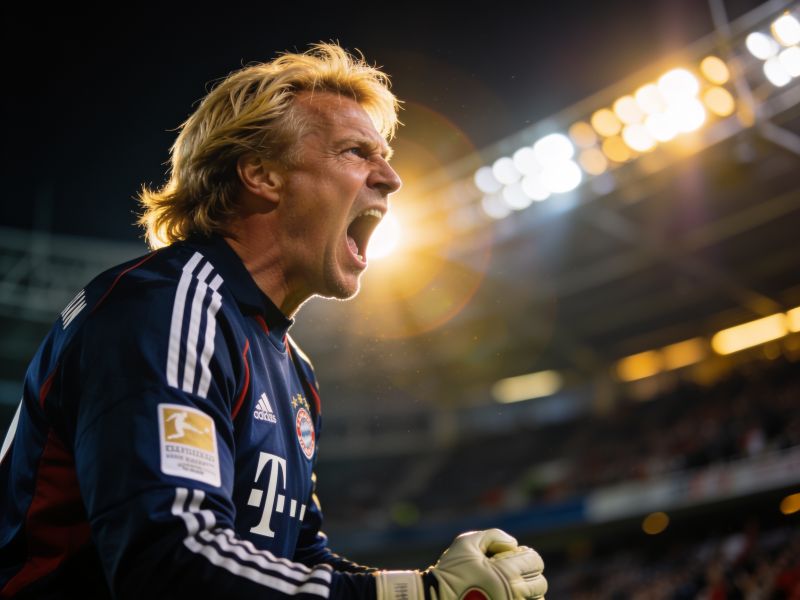
he was a psychological weapon.His career at Bayern Munich spanned fourteen years, from 1994 to 2008. Eight Bundesliga titles, six DFB-Pokals, one Champions League, and the 2001 Intercontinental Cup. But numbers don’t capture the sheer presence. Kahn revolutionized the position by playing as a sweeper-keeper before the term became trendy. He charged off his line with reckless authority, often clearing balls outside the box with his head or feet. Against Valencia in the 2001 Champions League final, he saved three penalties in the shootout—not by guessing, but by studying opponents’ body shapes. “I don’t dive to look good” he once said. “I dive to win” That line stuck with me because it defines his entire approach. For a German goalkeeper Kahn。winning was the only metric.Critics called him arrogant. Teammates called him demanding. I call him necessary. In an era when goalkeepers were expected to be quiet and deferential, Kahn screamed at defenders, punched crossbars, and even grabbed a teammate by the collar during a 2002 match against Austria. Was it excessive?Sure. But that raw edge made him the first goalkeeper to win the Golden Ball at a World Cup—awarded to the tournament’s best player in 2002. No keeper had ever done that. No keeper has done it since. His rivalry with Jens Lehmann for the national team spot became a national soap opera, yet Kahn handled it with a grim dignity. When Lehmann got the nod for the 2006 World Cup, Kahn didn’t sulk on the bench. He cheered, he mentored。
he shook Lehmann’s hand after the quarter-final shootout against Argentina. That moment, captured in a handshake that lasted three seconds, showed a side the cameras rarely caught.What makes a German goalkeeper Kahn so enduring isn’t the saves—it’s the template. Modern keepers like Manuel Neuer, Marc-André ter Stegen。
and even Alisson Becker owe a debt to Kahn’s aggressive positioning and mental warfare. Neuer, his direct successor at Bayern, once admitted he studied Kahn’s tapes to learn how to dominate the box. But Neuer is calmer, more calculated. Kahn was pure combustion. He retired in 2008 with 86 caps for Germany and over 800 club appearances. Now a TV pundit, he still criticizes goalkeepers who smile after conceding. “A goal against you should hurt” he says. “If it doesn’t, find another job” That’s Kahn. No滤镜, no apologies.I’ve rewatched his 2002 World Cup final performance twice. Germany lost 2-0, but Kahn made a save against Ronaldo in the first half that defied physics—a low drive that he somehow pushed around the post with his fingertips. He had a torn tendon in his right hand. He played anyway. You don’t see that kind of sacrifice often. German goalkeeper Kahn didn’t just play the position;he owned it. Love him or hate him, you remember him. And in football, memory is the only immortality that matters.