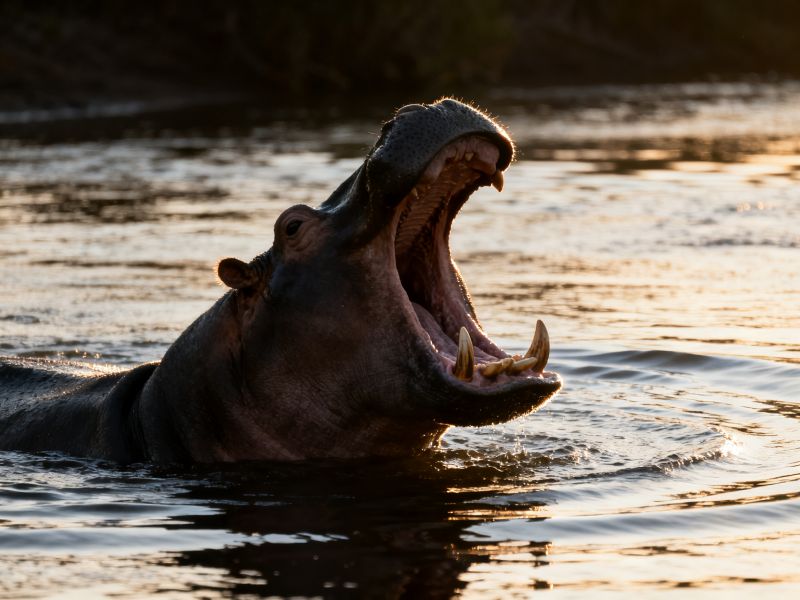
he hippo is not a gentle giant. A mature bull can weigh 1,500 kilograms and sprint at 30 kilometers per hour on land. That fact alone should dismantle any lingering image of the hippo as a sluggish, pond-dwelling herbivore. In Zambia's Luangwa River。I watched a pod of hippos for three hours. They stayed almost perfectly still, noses above the surface, eyes half-closed. Then a crocodile drifted too close to a calf. The water erupted. The crocodile vanished downstream. The hippo went back to looking like a muddy boulder. That contrast—lethargy and explosive aggression—is the hippo's core survival strategy, and it shapes everything from riverbank vegetation to the mating rituals of fish.Most people think hippos eat grass and little else. True enough, they graze at night, cropping short grasses on land. But the hippo's ecological footprint is far larger than its diet. Where hippos gather, they fertilize the water with nitrogen and phosphorus from their dung. In the Mara River, researchers have traced these nutrients into the food web—algae, insects。fish. The hippo becomes a nutrient pump, moving nutrients from land to water. That process changes water chemistry. It also supports fish populations that local communities depend on. Ignore the hippo and you misread the river's entire economy.Aggression among hippos is not random chaos. Dominant bulls control stretches of riverbank, and their territorial disputes follow predictable patterns. I once observed a bachelor male attempt to sneak into a herd's territory at dusk. The resident bull responded with a series of yawns—wide, deliberate。displaying massive canines. It looked comical. The intruder retreated. That yawn is a warning, not a yawn. Hippos also use vocalizations that carry both above and below water. Their calls are loud enough to travel through the ground, and other hippos pick up the vibrations through their feet. Communication is a full-body experience for a hippo.Hippo populations are falling. The IUCN lists the hippo as Vulnerable, with an estimated 115,000 to 130,000 individuals remaining in the wild. Habitat loss and poaching drive the decline。but so does something less obvious: human-wildlife conflict. Hippos raid crops at night. Farmers retaliate. In the Okavango Delta, electric fences have reduced conflicts, but they fragment hippo habitat and cut off traditional movement corridors. Conservationists are experimenting with buffer crops and night patrols. None of these fixes are simple. The hippo is a large animal with large needs, and it does not compromise easily.
I used to think of the hippo as a relic—a creature from a slower, wetter world. That view was lazy. The hippo engineers its environment。enforces territorial rules, and links land and water in ways scientists are still quantifying. Its presence or absence tells you a great deal about a river's health. The next time you see a hippo surface, look past the calm eyes. That animal is a force of nature, and it is not asking for permission to be one.